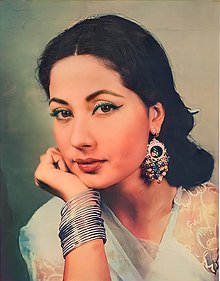
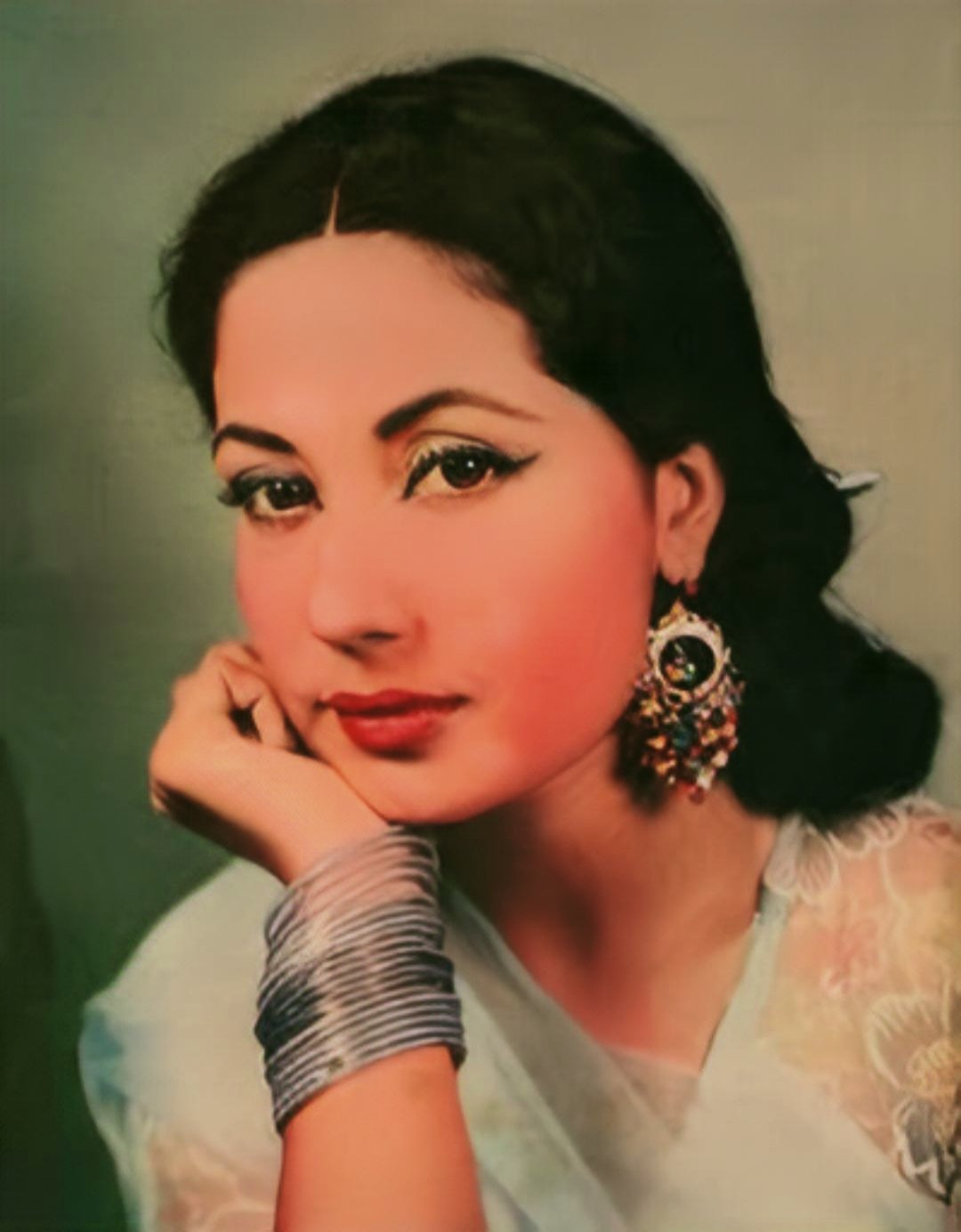
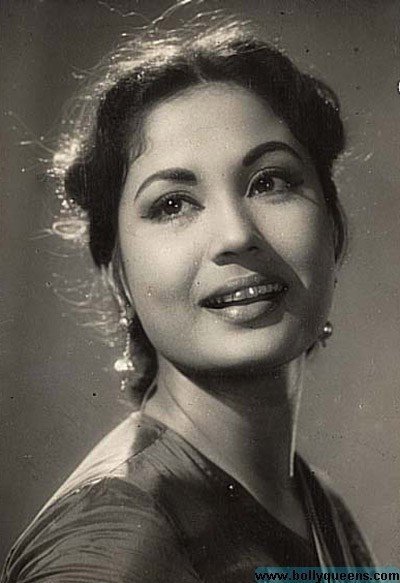
Meena Kumari (1 August 1933 – 31 March 1972), born Mahjabeen Bano, was a celebrated Indian actress, singer, and poet widely regarded as one of the greatest figures in Hindi cinema.
Known as the “Cinderella of Indian Movies” and the “Tragedy Queen of Bollywood,” she starred in approximately 92 films during her 33-year career spanning from 1939 to 1972.
Meena Kumari was born in Bombay (now Mumbai) into a poor Parsi theatre family; her father was Master Ali Bux (also called Ali Baksh), who migrated from Bhera, and her mother was Iqbal Begum, a Bengali Christian who converted to Islam.
| Full Name | Meena Kumari |
| Nick Name | Mahjabeen Bano |
| Other Name(s) | Tragedy Queen |
| Occupation | Actress/Poet/Singer/Costume Designer |
| Date of Birth | 01-August-1933 (38 years) |
| Birth Location | Bombay, Bombay Presidency, British India |
| Gender | Female |
| Nationality | Indian |
| Religion | Muslim |
| Zodiac Sign |
Leo  |
| Death Time | 31-March-1972 |
| Death Location | Bombay, Maharashtra, India |
| Height | 160 cm |
| Weight | 55 kg |
| Eye Colour | Black |
| Hair Colour | Black |
| Hobbies | Dancing and singing |
Her original name was Mehajabeen Naaz (or Mahjabeen Bano), and director Vijay Bhatt renamed her “Baby Meena” for her first film. She made her acting debut at age 7 in Farzande Watan (also called Farzand-e-Watan or Leatherface) in 1939, playing Jairaj Singh’s daughter. During the 1940s, she became practically the sole breadwinner for her family.
In her early adult career under the name Meena Kumari, she appeared mainly in mythological films such as Veer Ghatotkach (1949), Shri Ganesh Mahima (1950), and fantasy movies like Alladin and The Wonderful Lamp (1952).
She gained fame as a heroine in Vijay Bhatt’s Baiju Bawra (1952), becoming the first actress to win the Filmfare Best Actress Award in 1953 for this performance. She was renowned for portraying suffering women in classic films like Parineeta (1953), Daera (1953), Ek Hi Raasta (1956), Sharda (1957), and Dil Apna Aur Preet Parayi (1960). Though cultivated as a tragedienne, she also excelled in light-hearted movies including Azaad (1955), Miss Mary (1957), Shararat (1959), and Kohinoor (1960).
One of her most celebrated roles was in Sahib Bibi Aur Ghulam (1962), produced by Guru Dutt, for which she won the Filmfare Best Actress Award after making history by receiving all three nominations for the award that year (for Aarti, Main Chup Rahungi, and Sahib Bibi Aur Ghulam).
She won her fourth and final Filmfare Best Actress Award for Kaajal (1965). Her final and most iconic film, Pakeezah, was directed by her ex-husband Kamal Amrohi and took 14 years to complete.
Beyond acting, Meena Kumari was an accomplished poet who wrote Urdu poetry under the pseudonym Naaz. Although she had no formal education, she was well-versed in Urdu and Hindi, was an ardent reader, and published many of her poems. Her poetry explored themes of love, loneliness, wishes, dreams, betrayal, and exploitation, revealing a sensitive side distinct from her film roles. Her love for poetry brought her closer to renowned poet Gulzar.
Meena Kumari married filmmaker Kamal Amrohi, who she described as “the perfect man for her,” though they eventually divorced. Three weeks after Pakeezah’s release, she became seriously ill and died on 31 March 1972 at a hospital in Mumbai while in a coma from cirrhosis-related problems, at age 38.
At her death, she lacked money to pay her hospital bills, buried at Rahematabad Qabristan in Narialwadi, Mazgaon, Mumbai. Her life remains a roller coaster of passion, romance, love, success, and tragedy.
Prabhavati Devi
MotherIqbal Begum
MotherMaster Ali Bux
FatherKamal Amrohi
Spouse (m. 1952; sep. 1964)Photo Gallery



FAQ (Frequently Asked Questions)
Meena Kumari was 38 years old
Meena Kumari was born on 01-August-1933
Meena Kumari was born in Bombay, Bombay Presidency, British India
References
- https://en.wikipedia.org/wiki/Meena_Kumari
- https://www.imdb.com/name/nm0474932/
Recently Added





Popular Personalities