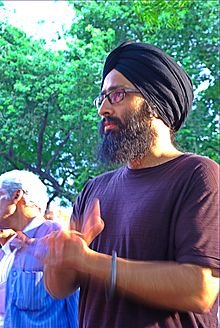
Rabbi Shergill (born Gurpreet Singh Shergill on 16 April 1972) is an Indian musician renowned for his debut album Rabbi and the chart-topping 2004 song Bullah Ki Jaana ("I don't know who I am!").
His music blends rock, Punjabi folk, and Sufi styles, described as "semi-Sufi semi-folksy kind of music with a lot of Western arrangements," and he has been called "Punjabi music's true urban balladeer".
He was born in Delhi, India, to a father who was a Sikh preacher and a mother who served as a college principal and Punjabi poet. This combination of Sikhism and poetry influenced his musical career. He completed his schooling at Guru Harkrishan Public School, India Gate, and graduated from Sri Guru Tegh Bahadur Khalsa College.
| Full Name | Rabbi Shergill |
| Occupation | Singer/Songwriter/Guitarist |
| Gender | Male |
He later attended Fore School of Management for further studies but dropped out after one year, having hated the management course. His interest in music was fueled by a Bruce Springsteen concert he attended in the late 1980s.
After college, he formed a band named Kaffir, which played at competitions and college festivals before disbanding. He initially composed advertisement jingles for Yamaha RX-T motorbikes and Times FM. Following unsuccessful attempts with Sony Music and Tehelka, he released his debut album Rabbi in 2004 under Phat Phish Records.
The album achieved chart-topping success through word-of-mouth publicity and a music video for "Bullah Ki Jaana," which is based on a Kafi poem by 18th-century Punjabi Sufi saint Bulleh Shah. Most songs on the album were composed and written by Shergill himself, except for "Bullah Ki Jaana" and two other traditional poems ["Heer" by Waris Shah and "Ishtihar" by Shiv Kumar Batalvi]. His song "Dilli" was featured in the Hindi film Delhii Heights.
In October 2008, Rabbi Shergill released his second album Avengi Ja Nahin under YRF Music, containing nine songs addressing communal violence (including the Bilkis Bano case), social responsibility, and collective morality.
He appeared on MTV Unplugged (India) in 2011 and sang "Challa" for Yash Chopra's 2012 romantic film Jab Tak Hai Jaan, composed by A. R. Rahman with lyrics by Gulzar. His third album III was released in March 2012. In 2013, he founded the independent label Odd One Out Records.
He has been critical of contemporary Punjabi singers like Diljit Dosanjh, generalizing popular Punjabi music as narcissistic, and has also criticized A. R. Rahman for ruining Bollywood music due to poor lyrics.
His principal contribution to music lies in using Punjabi to which he provided acoustic rock-based ballads with poetic, socially relevant lyrics and an adult alternative sound. His songs are deeply philosophical, blending archaic, nearly lost Punjabi phrases into contemporary Indian rock music.
His musical inspirations include Rock, Sufi, and Punjabi folk music, with favorite musicians Bruce Springsteen, Led Zeppelin, Aerosmith, and Jimmy Page. He worked with award-winning mix engineer Gustavo Celis on tracks for his album III.
Rabbi Shergill has four sisters, including Gagan Gill, a well-known Hindi poet. He married an Italian woman and has two children, a daughter and a son. Though he has a house in Mumbai, he prefers staying in Delhi.
His studio albums include Rabbi (2004), Avengi Ja Nahin (2008), and Rabbi III (2012). His film soundtrack contributions include "Challa" from Jab Tak Hai Jaan (2012), "Tu Mon Shudi" from Raanjhanaa (2013), and "Bulleya" from Romeo Akbar Walter (2019).
FAQ (Frequently Asked Questions)
-
Rabbi Shergill was born on -
Rabbi Shergill was born in -
References
- https://en.wikipedia.org/wiki/Rabbi_Shergill
Recently Added



Popular Personalities